<Lean Event Name> <Conducted Date(s)> <Evaluated Date(s)> BB: (Name) Champion: (Name)
Defining the Kaizen  Focus and Value
Define VOC, VOB Voice of the customer Voice of the business Add slides with pictures, words, graphs, cartoons, clipart or whatever will communicate as appropriate to show “the story”.
Customer CTQ Tree  The Voice of the Customer and the Voice of the Business is copied into here. Need Drivers CTQ’s Q1= Q2 - P1 - Q1 - KPI Driver 1 Driver 2 Driver 3 General Hard to measure Specific Easy to measure Q2-
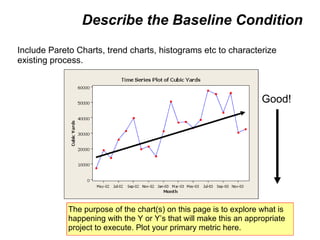
Describe the Baseline Condition Include Pareto Charts, trend charts, histograms etc to characterize existing process. The purpose of the chart(s) on this page is to explore what is happening with the Y or Y’s that will make this an appropriate project to execute. Plot your primary metric here. Good!
Project Charter {Project Name & No. Here} Assigned Define Measure Analyze Improve Control Sched Date Date Date Date Date Date Actual Date Date Date Date Date Date Process Map Number:   Number here Black Belt:  Name here Process Owner:  Name here Champion:  Name here Implementation Coordinator : Name here Data Coordinator : Name here Team Members: Name & function here Name & function here Name & function here Name & function here Name & function here Expected Benefits:   Hard Savings – xxx $K Soft Savings – xxx $K Other Benefits: List benefit here List benefit here Project Timeline: Customer CTQ(s):  Describe customer CTQ (customer need/defect and spec limit.) Problem Statement : List the 4 elements of a problem statement:  * Defect identification  * Magnitude of the defect (events/unit time, etc)  * Where is the defect (location/group/segment)  * Why this project is important to work now ($, BHAG support, etc) Project Scope: List project/process boundaries here by using includes … and excludes … Goal Statement:  Increase(/decrease) the {primary metric} from {baseline state} to {improved state} by {date} without negatively impacting {secondary metric}.
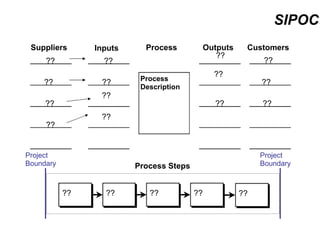
SIPOC Suppliers Inputs Process Outputs Customers ?? ?? Process Description  ?? ?? ?? ?? ?? ?? Process Steps Project Boundary Project Boundary ?? ?? ?? ?? ?? ?? ?? ?? ?? ?? ??
Included/Excluded INCLUDED What __________________  Where _________________ When __________________ Who ___________________ Other __________________ EXCLUDED _____________________ _____________________ _____________________ _____________________ _____________________
Quantify Project Value Hard $$ savings Dollars a Manager/Director and VP are willing to remove from budgets Soft $$ savings Savings dollars identified but no one is willing to remove them from a budget Productivity improvement Work content and/or results delivered improvements Internal customer satisfaction External customer satisfaction Be sure to show $ broken down by savings category Cost Center number which will receive the savings
Kaizen Team Key Stakeholders Define Measure Analyze Improve Control John M M M M M Paul A A A A A George R M M R R Ringo I R I I I A  - Approval of team decisions outside their charter/authorities, i.e., sponsor, business leader. R  - Resource to the team, one whose expertise, skills, “clout” may be needed on an  ad-hoc  basis. M  - Member of team, with the authorities and boundaries of the charter. I  - Interested party, one who will need to be kept informed on direction, findings, if later support is to be forthcoming. Project Phase
Pre-Event Work
Document Existing Process Document what is actually happening in the workplace Flow charts are often useful Pictures are very useful Videos are often useful Cartoons and clip art can be helpful to communicate the “as-found” condition
Identify Targets of Opportunity List the expected focus area(s) of the event. Could include, for example: Materials Tools Supplies Etc…
Pre-Session Research Identify the data and information collected prior to the working session. Some examples could include: Inventory usage history History of purchases Labor times or work content Scale drawing of the work area A basic process flow diagram  etc….
Communicate and Secure Communication to assure resources are available to do the work Commitment from participants and their superiors to do the work
All Ready Check Point Is the Champion happy with and in agreement to support: The Purpose of the Project? The Committed Resources to Execute the Project? The Effort That Will Be Necessary to Deploy Changes? The Conclusion of the Project Which May Not Align With Pre-Conceived Notions of the Right Solution?
During the Event
Documented Baseline For the baseline state, create some form of clear record of where the project bagan Flow charts are often useful Pictures are very useful Videos are often useful Cartoons and clip art can be helpful to communicate the “as-found” condition
Work Product Document the desired future state defined by the group Flow charts are often useful Pictures are very useful Videos are often useful Cartoons and clip art can be helpful to communicate the “future-state” condition
Document the Transition Plan Item Description  Responsibility Date Write new procedures Identify which procedures need to be documented Identify who will do it Identify when it will be done Train employees Identify which employees need to be trained Identify who will do it Identify when it will be done Use this slide to list the things that must be accomplished to transition from the baseline state to the envisioned future state
Assuring Implementation
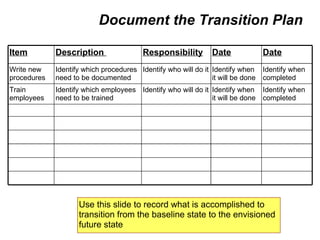
Document the Transition Plan Item Description  Responsibility Date Date Write new procedures Identify which procedures need to be documented Identify who will do it Identify when it will be done Identify when completed Train employees Identify which employees need to be trained Identify who will do it Identify when it will be done Identify when completed Use this slide to record what is accomplished to transition from the baseline state to the envisioned future state
Control Phase
Control Tools Identify what has been put in place to assure the sustenance for the benefits of the new current state. Some possible examples: Color coding Physical restrictions Replenish methods Periodic management review Etc.
Was It Worth It? PO, Champion, and MBB need to agree on benefits calculations. Be sure to show $ broken down by savings category Cost Center number which will receive the savings Final posted version should state that savings have been reviewed with Champion and that the Champion agrees with values
Closing Report This document is the final report for this project.  Transition information to support the flow of the report is included in the speaker notes. If there are further questions, please contact <Black/Green Belt> at 665-XXXX

Blank Logo LEAN template

  • 1.
    <Lean Event Name><Conducted Date(s)> <Evaluated Date(s)> BB: (Name) Champion: (Name)
  • 2.
    Defining the Kaizen Focus and Value
  • 3.
    Define VOC, VOBVoice of the customer Voice of the business Add slides with pictures, words, graphs, cartoons, clipart or whatever will communicate as appropriate to show “the story”.
  • 4.
    Customer CTQ Tree The Voice of the Customer and the Voice of the Business is copied into here. Need Drivers CTQ’s Q1= Q2 - P1 - Q1 - KPI Driver 1 Driver 2 Driver 3 General Hard to measure Specific Easy to measure Q2-
  • 5.
    Describe the BaselineCondition Include Pareto Charts, trend charts, histograms etc to characterize existing process. The purpose of the chart(s) on this page is to explore what is happening with the Y or Y’s that will make this an appropriate project to execute. Plot your primary metric here. Good!
  • 6.
    Project Charter {ProjectName & No. Here} Assigned Define Measure Analyze Improve Control Sched Date Date Date Date Date Date Actual Date Date Date Date Date Date Process Map Number: Number here Black Belt: Name here Process Owner: Name here Champion: Name here Implementation Coordinator : Name here Data Coordinator : Name here Team Members: Name & function here Name & function here Name & function here Name & function here Name & function here Expected Benefits: Hard Savings – xxx $K Soft Savings – xxx $K Other Benefits: List benefit here List benefit here Project Timeline: Customer CTQ(s): Describe customer CTQ (customer need/defect and spec limit.) Problem Statement : List the 4 elements of a problem statement: * Defect identification * Magnitude of the defect (events/unit time, etc) * Where is the defect (location/group/segment) * Why this project is important to work now ($, BHAG support, etc) Project Scope: List project/process boundaries here by using includes … and excludes … Goal Statement: Increase(/decrease) the {primary metric} from {baseline state} to {improved state} by {date} without negatively impacting {secondary metric}.
  • 7.
    SIPOC Suppliers InputsProcess Outputs Customers ?? ?? Process Description ?? ?? ?? ?? ?? ?? Process Steps Project Boundary Project Boundary ?? ?? ?? ?? ?? ?? ?? ?? ?? ?? ??
  • 8.
    Included/Excluded INCLUDED What__________________ Where _________________ When __________________ Who ___________________ Other __________________ EXCLUDED _____________________ _____________________ _____________________ _____________________ _____________________
  • 9.
    Quantify Project ValueHard $$ savings Dollars a Manager/Director and VP are willing to remove from budgets Soft $$ savings Savings dollars identified but no one is willing to remove them from a budget Productivity improvement Work content and/or results delivered improvements Internal customer satisfaction External customer satisfaction Be sure to show $ broken down by savings category Cost Center number which will receive the savings
  • 10.
    Kaizen Team KeyStakeholders Define Measure Analyze Improve Control John M M M M M Paul A A A A A George R M M R R Ringo I R I I I A - Approval of team decisions outside their charter/authorities, i.e., sponsor, business leader. R - Resource to the team, one whose expertise, skills, “clout” may be needed on an ad-hoc basis. M - Member of team, with the authorities and boundaries of the charter. I - Interested party, one who will need to be kept informed on direction, findings, if later support is to be forthcoming. Project Phase
  • 11.
  • 12.
    Document Existing ProcessDocument what is actually happening in the workplace Flow charts are often useful Pictures are very useful Videos are often useful Cartoons and clip art can be helpful to communicate the “as-found” condition
  • 13.
    Identify Targets ofOpportunity List the expected focus area(s) of the event. Could include, for example: Materials Tools Supplies Etc…
  • 14.
    Pre-Session Research Identifythe data and information collected prior to the working session. Some examples could include: Inventory usage history History of purchases Labor times or work content Scale drawing of the work area A basic process flow diagram etc….
  • 15.
    Communicate and SecureCommunication to assure resources are available to do the work Commitment from participants and their superiors to do the work
  • 16.
    All Ready CheckPoint Is the Champion happy with and in agreement to support: The Purpose of the Project? The Committed Resources to Execute the Project? The Effort That Will Be Necessary to Deploy Changes? The Conclusion of the Project Which May Not Align With Pre-Conceived Notions of the Right Solution?
  • 17.
  • 18.
    Documented Baseline Forthe baseline state, create some form of clear record of where the project bagan Flow charts are often useful Pictures are very useful Videos are often useful Cartoons and clip art can be helpful to communicate the “as-found” condition
  • 19.
    Work Product Documentthe desired future state defined by the group Flow charts are often useful Pictures are very useful Videos are often useful Cartoons and clip art can be helpful to communicate the “future-state” condition
  • 20.
    Document the TransitionPlan Item Description Responsibility Date Write new procedures Identify which procedures need to be documented Identify who will do it Identify when it will be done Train employees Identify which employees need to be trained Identify who will do it Identify when it will be done Use this slide to list the things that must be accomplished to transition from the baseline state to the envisioned future state
  • 21.
  • 22.
    Document the TransitionPlan Item Description Responsibility Date Date Write new procedures Identify which procedures need to be documented Identify who will do it Identify when it will be done Identify when completed Train employees Identify which employees need to be trained Identify who will do it Identify when it will be done Identify when completed Use this slide to record what is accomplished to transition from the baseline state to the envisioned future state
  • 23.
  • 24.
    Control Tools Identifywhat has been put in place to assure the sustenance for the benefits of the new current state. Some possible examples: Color coding Physical restrictions Replenish methods Periodic management review Etc.
  • 25.
    Was It WorthIt? PO, Champion, and MBB need to agree on benefits calculations. Be sure to show $ broken down by savings category Cost Center number which will receive the savings Final posted version should state that savings have been reviewed with Champion and that the Champion agrees with values
  • 26.
    Closing Report Thisdocument is the final report for this project. Transition information to support the flow of the report is included in the speaker notes. If there are further questions, please contact <Black/Green Belt> at 665-XXXX